Subterranean relative humidity levels above 70 percent convert subfloor joists into prime feeding grounds for wood-destroying organisms. Pittsburgh's steep river valleys and clay-heavy soils direct gallons of…
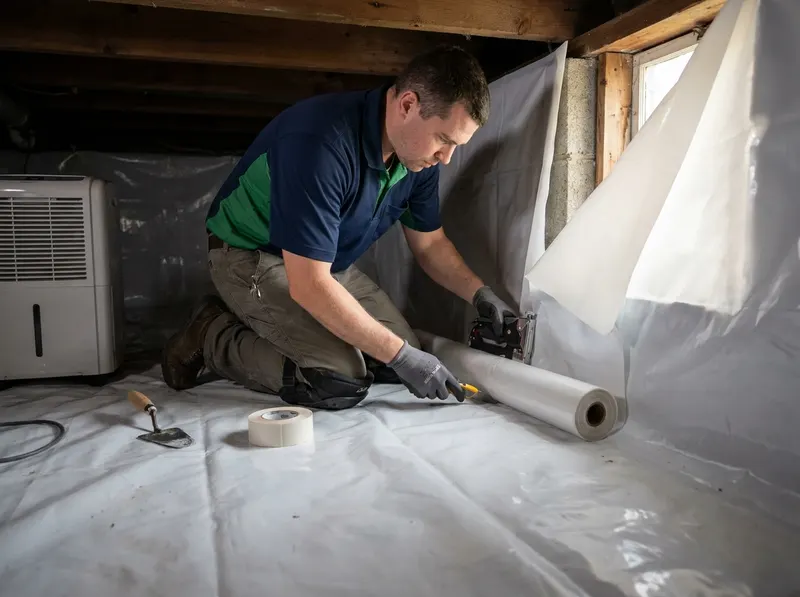
Subterranean relative humidity levels above 70 percent convert subfloor joists into prime feeding grounds for wood-destroying organisms. Pittsburgh's steep river valleys and clay-heavy soils direct gallons of groundwater toward foundation footings, particularly beneath century-old brick rowhouses in Bloomfield, Lawrenceville, and the South Side Flats. Unsealed dirt crawlspaces and porous sandstone rubblestone basements in Squirrel Hill and Shadyside release pounds of water vapor upward via the stack effect. This constant humidity causes structural subfloor wood rot, activates mold growth, and provides the exact nesting habitat required by subterranean termites, silverfish, and field mice. Vapor barrier remediation replaces torn, fungal-laden sheets with continuous 12-mil to 20-mil nylon-reinforced poly membranes mechanically anchored to masonry perimeter walls with butyl tape and zinc fasteners.
Decision guidance hinges on current foundation construction. Standard thin poly sheeting laid loosely over uneven dirt frequently slips, leaving exposed mud that sustains pest harborages. Complete crawlspace encapsulation involves overlapping seams by a minimum of 12 inches, taping joints with acrylic vapor tape, sealing support piers, and addressing open exterior foundation vents. Homes situated on steep slopes in Mount Washington or hillside contours in Brookline and East Liberty often encounter surface water intrusion alongside vapor transmission. In properties with active standing puddles, installing a submersible sump pump and interior drainage perimeter before laying the polyethylene barrier is necessary to protect the barrier integrity. While a standalone vapor barrier mitigates rising capillary moisture, addressing pooling runoff requires this dual-stage approach to ensure long-term stability.
Every remediation protocol adheres to structural Integrated Pest Management standards. Indiscriminate chemical spraying beneath floor joists fails to solve persistent pest pressures when damp soil remains unaddressed. Technicians deploy in unmarked service vehicles to preserve client discretion on compact neighborhood streets. All mechanical work focuses on drying the framing cavity, eliminating wood-decay dampness, and structurally sealing subterranean entry conduits so children and household pets remain protected without relying on open indoor rodenticides or repeated pesticide broadcast applications. Pricing starts at the $300 service baseline, with typical whole-crawlspace projects scaling from $1,200 to $4,500 based on access clearance and total square footage.
Every job gets a firm, written price after a free on-site visit.
Tell us about your crawlspace and basement moisture vapor barrier remediation job in Pittsburgh and we'll send a clear, written quote, usually the same day.
 Rendivo Exterminators