Targeted rodent exclusion stops infestations by removing access rather than relying on ongoing chemical applications. Standard pest control programs often depend on anticoagulant bait stations, which kill individual…
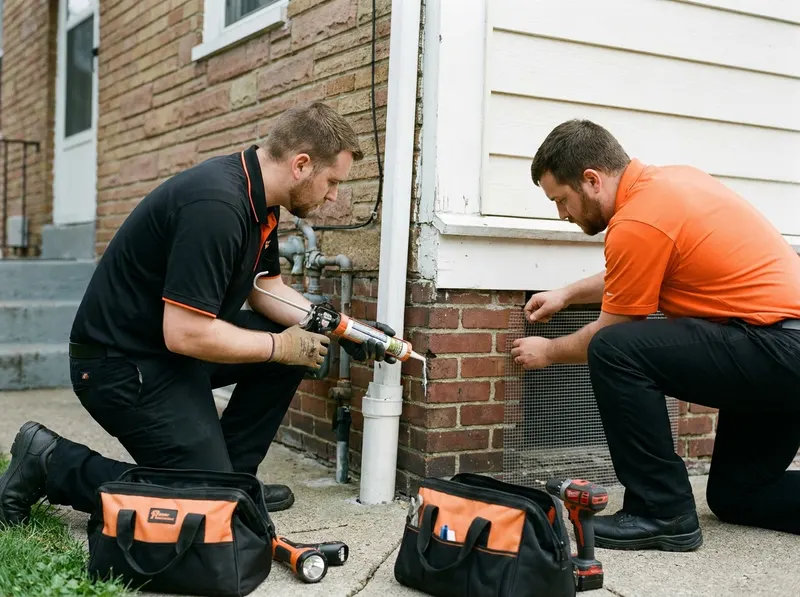
Targeted rodent exclusion stops infestations by removing access rather than relying on ongoing chemical applications. Standard pest control programs often depend on anticoagulant bait stations, which kill individual rodents but leave foundation gaps unaddressed, allowing new populations to enter through mortar voids. Exclusion replaces continuous baiting cycles with permanent physical barriers, which prevents structural nesting and eliminates the risk of contaminated surfaces or trapped animals decaying inside wall cavities. When addressing an active breach, interior snap traps run concurrently for 7 to 10 days to remove stranded animals, while the exterior barrier prevents secondary intrusions.
Pittsburgh housing architecture presents specific structural vulnerabilities due to the prevalence of fieldstone foundations, weathered brick ledges, and settling wood framing. In older brick rowhouses throughout Lawrenceville, Bloomfield, and South Side Flats, shared party walls and shifting sill plates frequently create quarter-inch foundation fissures that house mice exploit. Properties bordering dense green spaces in Squirrel Hill, Shadyside, and Highland Park encounter heavier Norway rat pressure along perimeter rubble stone walls. A juvenile mouse can penetrate an opening measuring 0.25 inches across, while a Norway rat requires a 0.5-inch gap. Sealing these zones requires anchoring quarter-inch galvanized mesh directly into mortar joints and covering low-hanging utility feed lines to eliminate climbing pathways.
Technicians implement exclusion in three sequential steps. First, an operative inspects the foundation perimeter from grade to roofline, recording gas penetrations, dryer exhausts, basement window frame rots, and crawl space vents. Second, entry passages receive backing materials composed of stainless steel wool or expanding poly foam laced with copper fibers, capped with non-shrink silicone or metal flashing. Third, interior snap traps capture any rodents remaining inside the living boundary, followed by an operational inspection on day 14 to verify barrier stability across Mount Washington, East Liberty, and Brookline properties.
Every job gets a firm, written price after a free on-site visit.
Tell us about your targeted rodent exclusion job in Pittsburgh and we'll send a clear, written quote, usually the same day.
 Rendivo Exterminators