Rendivo ExterminatorsRendivo Exterminators

Subterranean Termite Soil Treatment Pittsburgh

Eastern subterranean termites cause structural timber degradation by maintaining constant contact with damp soil horizons while tunneling into wooden framing. In Pittsburgh neighborhoods like Shadyside, Squirrel Hill,…
Get My Free Estimate →(412) 730-8164
Subterranean Termite Soil Treatment in Pittsburgh, PA
Quick answer
  • What is included: Perimeter trenching along foundation walls, masonry expansion-joint rodding, sub-slab foundation drilling, and placement of a continuous non-repellent termiticide barrier.
  • How fast: On-site inspections schedule within 24 to 48 hours; structural perimeter treatments take 4 to 8 hours depending on linear footage and basement configuration.
  • What it costs: Treatment ranges from $800 to $2,500 for single-family residences, priced at $9 to $16 per linear foot, with a strict $200 minimum assessment standard.
  • What we target: Eastern subterranean termites (Reticulitermes flavipes) nesting in deep soil deposits, mud shelter tubes, and infested sill plates or floor joists.
  • How to schedule: Call (412) 730-8164 to arrange a diagnostic foundation examination, or send photos of discovered mud tubes and damaged lumber for initial triage.

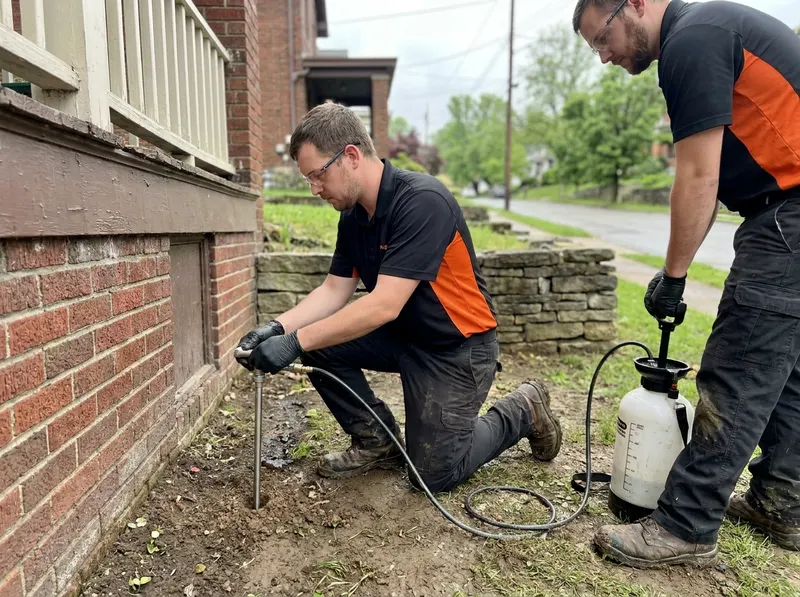
Eastern subterranean termites cause structural timber degradation by maintaining constant contact with damp soil horizons while tunneling into wooden framing. In Pittsburgh neighborhoods like Shadyside, Squirrel Hill, and Highland Park, older residential architecture presents porous brick footings, stone rubblestone foundations, and crawl spaces that provide direct subterranean access points. Continuous liquid barrier trenching places non-repellent termiticides, such as fipronil, at labeled depths of 4 gallons per 10 linear feet per foot of depth down to the top of the footer. Unlike older organophosphate repelling agents that termites simply detour around, modern non-repellent solutions transfer undetectable active ingredients through social grooming habits throughout the underground colony, neutralizing the population within 60 to 90 days.

Dense hillside topography and varied masonry along Mount Washington, South Side Flats, and Lawrenceville necessitate distinct application protocols. Concrete basement slabs, integrated garages, and rear brick patios require precision hammer-drilling through masonry slabs at 12-inch intervals to reach sub-slab dirt. If a structure features exterior earth beds directly abutting wooden sill plates, trenching soil down to 6 inches wide and 6 inches deep ensures the chemical bonds firmly with heavy Allegheny County clay. When high groundwater or proximity to water features makes trench saturation impossible, specialized localized baiting networks serve as the primary alternative; however, liquid perimeter barriers offer immediate mechanical containment that protects framing without waiting for foraging worker termites to discover monitoring stations.

Homeowners in Bloomfield, Brookline, and East Liberty frequently mistake winged subterranean reproductive swarmers for harmless flying ants during humid spring conditions between March and May. Termites exhibit straight, beaded antennae, uniform waistlines, and equal-sized wings, whereas ants show pinched waists and uneven wing sets. Liquid barrier installations dry clear and bind tightly to soil colloids, preventing chemical leaching into interior living zones or neighboring domestic groundwater. Treated sites remain systematically protected for 5 to 10 years when surface soil grading remains undisturbed by exterior landscaping renovations.

Subterranean Termite Soil Treatment cost in Pittsburgh

Minimum Diagnostic Assessment$200
Exterior Foundation Trenching (Small Footprint / Rowhome)$800 - $1,350
Full Perimeter Trench & Sub-Slab Rodding (Standard Single-Family)$1,200 - $2,200
Extensive Footprint / Multi-Level Hillside Application$1,800 - $2,500+

Every job gets a firm, written price after a free on-site visit.

Common questions

How does subterranean termite soil treatment work in Pittsburgh homes with stone foundations?
Stone and rubblestone foundations common in older Pittsburgh homes require low-pressure perimeter sub-slab rodding and deep foundation trenching to saturate the mortar junctions where subterranean termites enter.
What is the difference between soil barrier treatment and termite bait stations in Pittsburgh?
Soil barrier treatment installs an uninterrupted liquid zone around the foundation that works immediately upon contact, while termite bait stations rely on foraging worker termites finding wooden monitors over a multi-month period.
Does heavy clay soil in Allegheny County impact termiticide effectiveness?
Heavy Allegheny County clay holds termiticide compounds securely at target depths once injected, preventing chemical wash-off and extending barrier durability compared to loose, sandy ground.
Are subterranean termite soil treatments safe for pets and children around Pittsburgh residences?
Liquid treatments bind directly to sub-surface soil particles beneath top layers, ensuring family members and domestic pets have zero direct contact once the surface soil dries completely within 2 to 4 hours.
How long does a professional termite soil barrier last in Pittsburgh weather conditions?
A continuous non-repellent liquid soil treatment remains stable and active in Pittsburgh ground conditions for 5 to 10 years, provided foundation grading, trench soil, and drainage systems remain undisturbed.
Helpful resources

Trusted references & local links

USA.gov, government & consumer helpBetter Business BureauFTC Consumer AdviceU.S. Small Business AdministrationReady.govU.S. EPAENERGY STARU.S. Dept. of EnergyConsumer.govU.S. Census BureauGoogle Maps, Pittsburgh, PA

Get started today

Tell us about your subterranean termite soil treatment job in Pittsburgh and we'll send a clear, written quote, usually the same day.
Get your free pest control services quote, Pittsburgh

We only use your ZIP to check availability, no spam.